 Solar $ Holistic Financial Planninga WeCology app for GeoDataTrackOpen the plannerSolar $ Holistic Financial Planninga WeCology app for GeoDataTrackOpen the planner
Wealth comes from the sun and results in growth. Money is a tool to grow the whole.
Solar $ Holistic Financial Planning is a dashboard for the money side of Holistic Management, built on the Holistic Financial Planning (HFP) method. Plan the profit first. Test every big spending decision against your holistic context. Then watch the plan against reality month by month, and correct course early.
Most farm budgets start with last year's costs and hope profit is left over. Holistic Financial Planning (HFP) starts the other way round. You decide the profit you need, set it aside, and plan expenses from what remains. Wealth-generating spending comes first: money that addresses the weak link in each enterprise or breaks a logjam. Then come the inescapable costs, and maintenance gets what is left.
Holistic Management calls the money that matters most solar dollars: income from converting the day's sunlight through plants, animals and people. Mineral dollars come from what is dug up; paper dollars come from money itself. Solar $ tags income by type so you can see how much of the business grows from the sun.
The method is the Savory Institute / 3LM Holistic Financial Planning process (HFP Manual V8), built to Holistic Management, 3rd edition (ch. 39). Savory's claims about cause and effect are treated as working hypotheses to monitor, not settled fact: the book's own advice is to assume your plan is wrong and look for the early warnings.
The name comes from the WeCology essay Solar Dollar and Bare Ground (15 July 2026). Every morning the sun makes the farm an offer. Green leaf takes it and turns it into forage, liveweight and income. Bare ground turns it down: the light becomes heat and leaves by evening. That bare patch is refused solar income. It is also something you can read, because it says something about all four ecosystem processes: energy flow, the water cycle, the mineral cycle and community dynamics.
“The sun deposits energy each day; green leaf cashes it; bare soil leaves it in the account.”Darren Smith, WeCology, Solar Dollar and Bare Ground
The dollar is a way in, not the verdict. Use the figure to get yourself looking, then put it down and look at the land. Productivity is bigger than yield. Yield is tonnes off a field. Productivity is the ground's living capacity to catch light, hold water, cycle minerals and carry the community that keeps all three going. A field can post a fair yield for years while that capacity drains away underneath it.
“The dollar is a doorway. I wouldn’t mistake it for the room.”Darren Smith, WeCology, Solar Dollar and Bare Ground
What this means for the plan. In Holistic Financial Planning you plan the profit first, and you plan to earn it by turning more of each day's sunlight into product: more leaf, more cover, a bigger share of solar income. Profit is not profit if it comes from using up the soil. So a Solar $ plan sits next to what you see on the ground: the monitoring, the early warnings, and the land's response over time (EOV, through GeoDataTrack). If the figures look good and the ground looks worse, assume the plan is wrong and look again.
Anyone at any level of a land business:
Plan one property: whole under management, holistic context, gross profit analysis, profit first, the monthly plan and control.
An organisation manager sees every property, with a roll-up: summed plans, variance, and a property-by-property comparison.
Prepare figures and draft decision records for the decision makers. Outcomes stay with the owner or manager.
Board members, family, lenders: read the plan and the dashboard without changing anything.
Every change is recorded with who made it, their role and when.
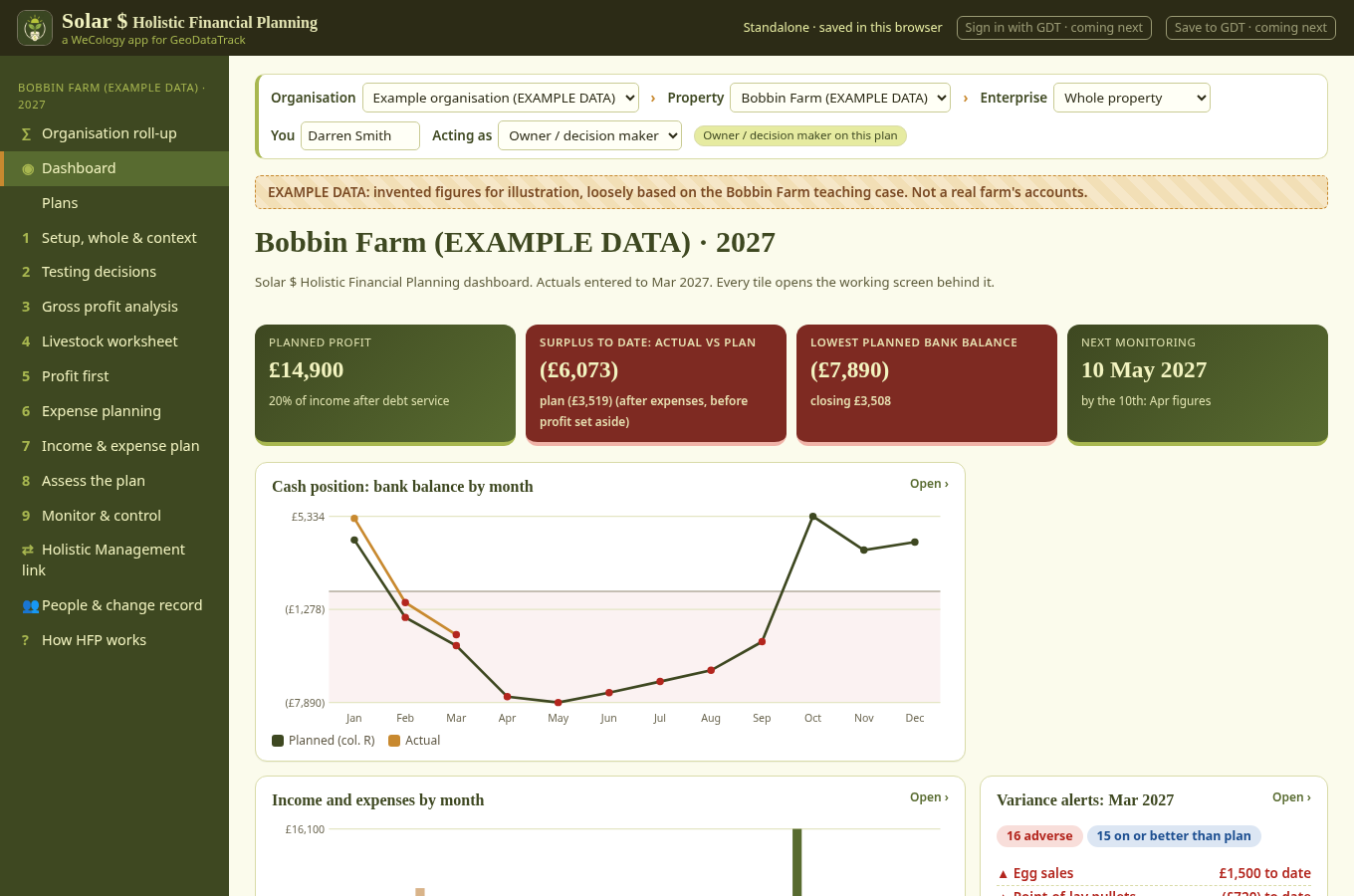
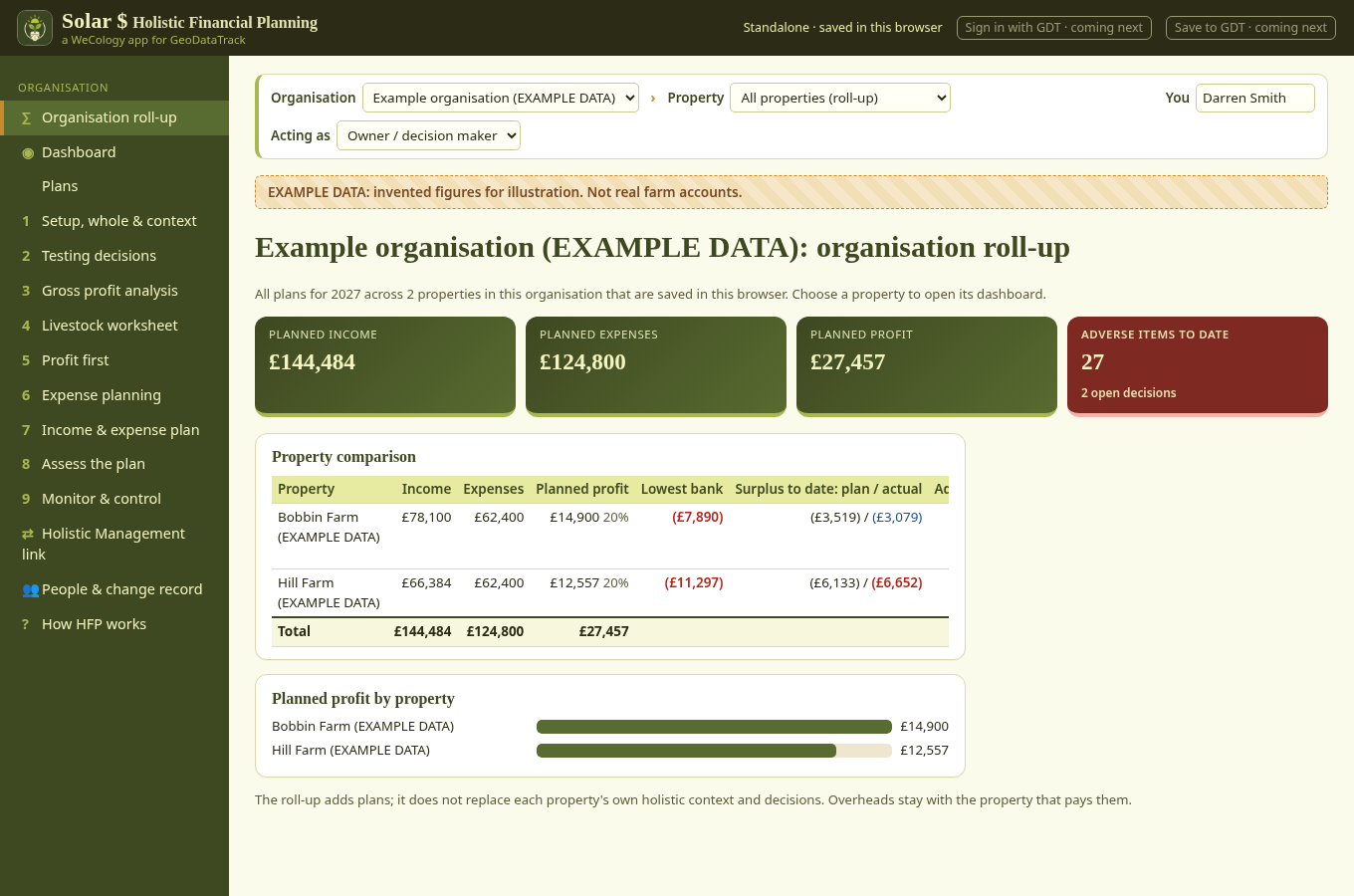
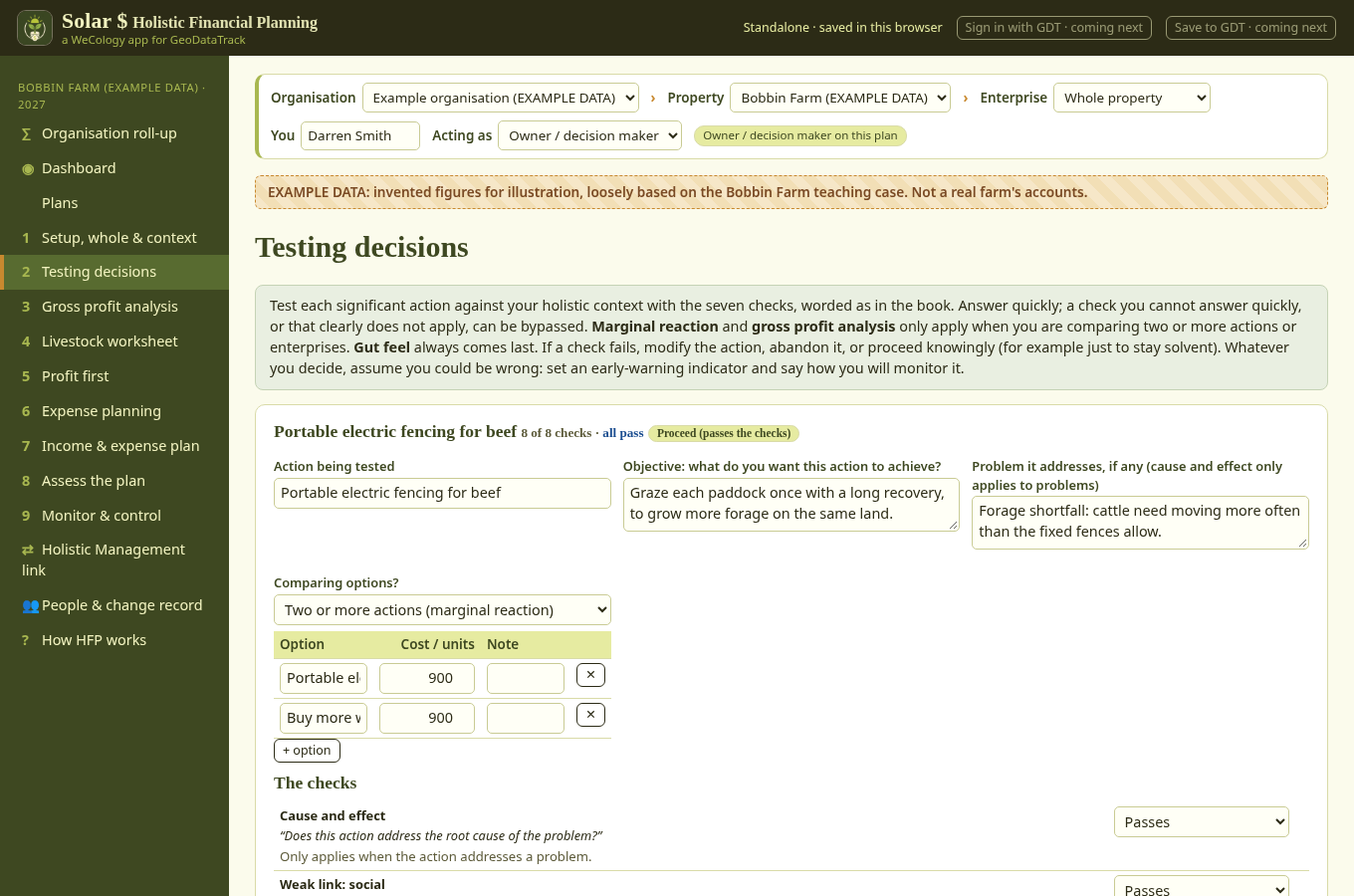
Solar $ is one part of whole-farm Holistic Management, not a separate budget. It works from the holistic context: the purpose, quality of life and future resource base that every decision is tested against. It feeds the results back as decision records, the logjam, weak links and monitoring alerts.
Holistic context, the whole under management, decision tests (context checks).
Profit first, gross profit analysis, the monthly plan, monitoring and control, financial decision records.
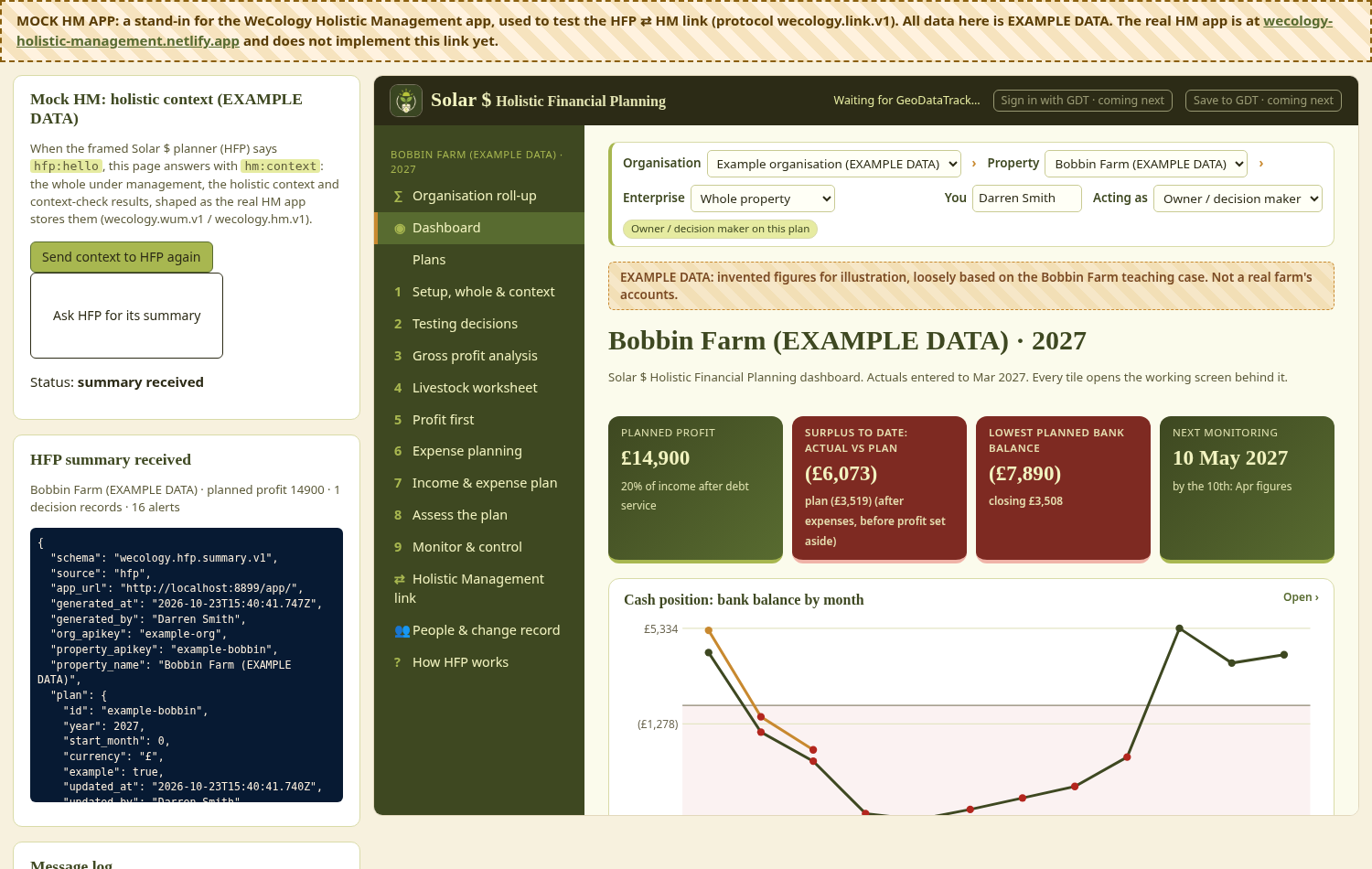
Talks to the Holistic Management app. Solar $ reads the purpose, quality of life, future resource base, the whole under management and decision-test results from the WeCology Holistic Management app. It writes back an HFP summary: planned profit, cash position, logjam, weak links, decision records with their check results and outcomes, and monitoring alerts.
The HM app stays the home of the holistic context. Today the link runs through a file exchange, and live in the browser when one app opens or frames the other (a versioned, origin-checked message protocol). The live link with the Holistic Management app is live: open Solar $ from HM and the two apps exchange the holistic context and the HFP summary for that property. A mock HM page with example data shows the exchange for testing. A shared store keyed by GeoDataTrack organisation and property comes later.
Solar $ runs as an app inside GeoDataTrack (GDT), opened from your organisation and property next to the WeCology Holistic Management app and EcoView. GDT supplies the organisation and property, and the land base: areas and hectares for gross profit per hectare. Later it will add the herd plan from grazing planning, and links to ecological monitoring (EOV) that show whether the land is moving towards your future resource base.
Your financial plan stays yours. GDT holds observed field data. Your planned and actual figures are kept apart from it, with a record of who changed what and when.
EIA, the Ecologically Intelligent Agent, will offer readings of your plan as dated drafts that you can accept or ignore. It gives questions, not scores. This is not built yet.
Status, October 2026: version 2 runs in your browser and saves plans on this device, grouped by organisation and property, ready for a shared store. GDT sign-in and saving are coming next. Try the example farm or the example organisation; their figures are invented example data.